
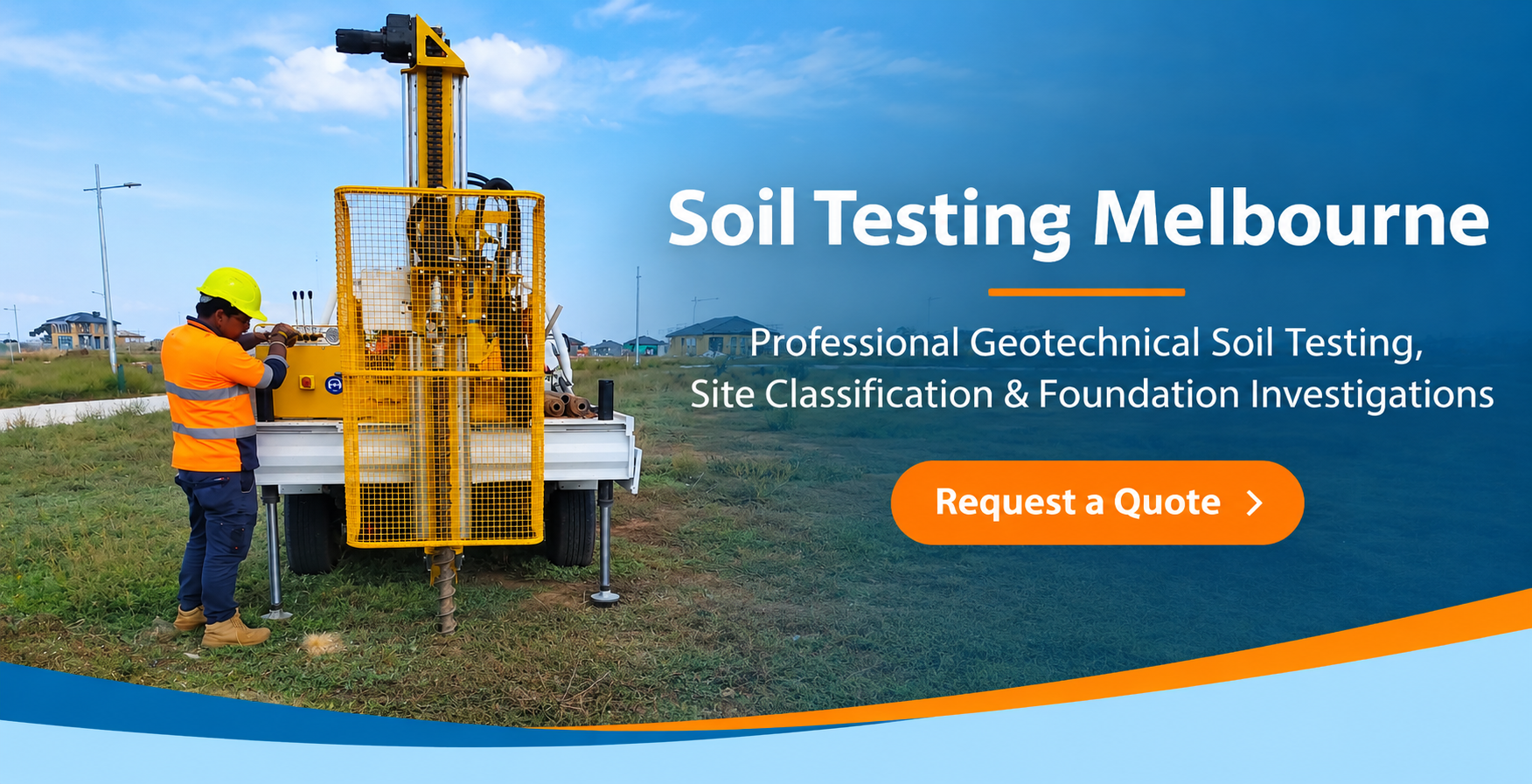
Soil Testing Melbourne – Professional Geotechnical Soil Testing Services
Geotechnical Engineering Services Pty Ltd (GES) provides professional soil testing Melbourne services for residential, commercial, industrial and civil construction projects throughout Greater Melbourne and surrounding regions of Victoria.
Our experienced geotechnical engineers conduct detailed soil investigations, borehole drilling, soil sampling, laboratory testing and site classification assessments to determine subsurface ground conditions and provide reliable geotechnical recommendations for foundation design and construction.
GES operates a NATA-accredited geotechnical testing laboratory, supporting our field investigations with soil testing and analysis in accordance with relevant Australian Standards.
Whether you are planning a new home, building extension, commercial development, retaining wall, pavement construction or civil infrastructure project, our soil testing services help engineers, builders and developers make informed decisions.
Our investigations are undertaken with reference to AS 1726 – Geotechnical Site Investigations, AS 2870 – Residential Slabs and Footings and relevant soil testing methods under AS 1289.
For professional soil testing and geotechnical engineering advice, contact GES to discuss your project requirements.
Why Is Soil Testing Important in Melbourne?
Soil testing is an important part of the planning, engineering design and construction process. Ground conditions across Melbourne can vary significantly depending on local geology, soil type, groundwater conditions, historical land use and previous earthworks.
Melbourne properties may contain reactive clay, sandy soils, uncontrolled fill, weathered rock, basalt and other geological materials that influence the performance of foundations and structures.
A professional soil testing Melbourne investigation helps identify:
Soil type, composition and subsurface profile.
Soil reactivity and potential ground movement.
Presence, thickness and condition of fill materials.
Soil consistency, density and strength.
Allowable bearing capacity for foundation design.
Groundwater conditions encountered during investigation.
Depth to suitable founding materials.
Potential foundation movement due to moisture changes.
Site conditions affecting construction and earthworks.
Suitable foundation options for the proposed development.
The information obtained from soil testing assists structural engineers in selecting appropriate footing systems and assessing geotechnical risks.
GES provides detailed geotechnical site investigation services to support residential and commercial construction projects.
Our Soil Testing Services in Melbourne
GES offers a comprehensive range of soil testing and geotechnical investigation services to support construction and engineering projects.
1. Residential Soil Testing Melbourne
Residential soil testing is commonly undertaken before constructing new homes, extensions, renovations, garages, granny flats and other residential structures.
Our residential investigations typically include borehole drilling, soil profile identification, assessment of soil reactivity and preparation of site classification reports.
Depending on the proposed development and ground conditions, our reports may provide recommendations for slab-on-ground foundations, strip footings, pad footings and bored piers.
GES undertakes residential site classification assessments in accordance with AS 2870 – Residential Slabs and Footings.
Learn more about our Residential Soil Testing Services.
2. Soil Classification Reports
A soil classification report identifies the ground conditions and assesses the potential movement of foundation soils due to moisture variation.
Under AS 2870, residential sites may be classified as Class A, S, M, H1, H2, E or P, depending on the applicable ground conditions and site characteristics.
Site classification considers factors such as soil reactivity, fill, trees, drainage, slope and other conditions that may affect foundation performance.
Our Soil Classification Report Melbourne service provides geotechnical information to assist structural engineers and builders with footing design.
3. Geotechnical Site Investigation
GES provides geotechnical investigations for commercial buildings, industrial facilities, residential developments and civil infrastructure.
Our investigations may include:
Mechanical auger drilling and soil sampling.
Hand auger investigations where access is restricted.
Borehole logging and subsurface soil identification.
Dynamic Cone Penetrometer (DCP) testing.
Standard Penetration Testing (SPT), where appropriate.
Soil consistency and strength assessment.
Groundwater observations.
Assessment of allowable bearing pressure.
Recommendations for shallow and deep foundations.
Investigation depth and testing requirements are determined based on the proposed structure, site conditions and project scope.
Explore our Geotechnical Site Investigation Services.
4. Geotechnical Laboratory Soil Testing
GES operates a NATA-accredited geotechnical testing laboratory to support engineering investigations, earthworks and pavement projects.
Our laboratory testing services include, where applicable:
Moisture content determination.
Atterberg limits testing.
Particle size distribution and sieve analysis.
Hydrometer analysis.
Standard and modified compaction testing.
California Bearing Ratio (CBR) testing.
Shrink-swell index testing.
Soil classification and engineering property assessment.
Testing is conducted using applicable Australian Standard methods, including the AS 1289 series, within the laboratory’s relevant accreditation scope.
Laboratory results provide important information about soil properties, compaction characteristics, plasticity, strength and potential volume changes.
For information about laboratory accreditation, visit the National Association of Testing Authorities (NATA).
5. Foundation and Footing Investigations
Suitable foundation design depends on the strength, stiffness and behaviour of the underlying soils.
GES conducts soil investigations to assess ground conditions and provide geotechnical design recommendations for:
Slab-on-ground foundations.
Pad and strip footings.
Bored piers.
Retaining wall foundations.
Building extensions.
Existing footing assessments.
Commercial and industrial foundations.
Depending on the investigation scope, our geotechnical reports may include recommended founding depths, allowable bearing pressures, preliminary end-bearing values and shaft adhesion parameters.
These recommendations assist qualified structural engineers in designing suitable foundation systems.
6. Pavement Subgrade Soil Testing
GES provides pavement subgrade investigations for roads, car parks, driveways, industrial hardstands and other pavement construction projects.
Our pavement investigations may include borehole drilling, DCP testing, soil sampling and laboratory CBR testing.
The results help pavement designers assess subgrade strength, soil variability and potential requirements for subgrade improvement.
We also provide Compaction Testing Melbourne services for earthworks and pavement construction.
7. Level 1 Earthworks Supervision and Compaction Testing
Properly controlled earthworks are essential for the performance of building foundations, pavements and engineered fill platforms.
GES provides geotechnical earthworks supervision and field density testing for residential, commercial and civil construction projects.
Our services include:
Level 1 earthworks supervision.
Inspection of fill placement and compaction.
Field density testing using nuclear density gauges.
Laboratory compaction testing.
Assessment of compaction compliance.
Earthworks documentation and reporting.
Earthworks supervision and testing are undertaken with reference to relevant requirements of AS 3798 – Guidelines on Earthworks for Commercial and Residential Developments.
Learn more about our Level 1 Earthworks Supervision services.
Our Soil Testing Process
GES follows a systematic approach to soil testing and geotechnical investigation.
Step 1 – Review Project Requirements
We review the site location, proposed construction, available drawings, site access and relevant project information to determine the appropriate investigation scope.
Step 2 – Site Investigation and Borehole Drilling
Our field team attends the site and undertakes borehole drilling or other investigation methods appropriate to the ground conditions and site access.
Soil samples are collected and subsurface conditions are recorded during the investigation.
Step 3 – Soil Identification and Field Testing
Soil types, moisture conditions, consistency, strength and other relevant characteristics are assessed.
Where required, field testing such as DCP, SPT or pocket penetrometer testing is undertaken.
Step 4 – Laboratory Testing
Selected soil samples may be tested in our geotechnical laboratory to determine engineering properties such as moisture content, plasticity, particle size distribution, compaction characteristics and CBR.
Step 5 – Geotechnical Assessment
Our geotechnical engineers review the field and laboratory results to assess soil behaviour, site classification, foundation conditions and relevant geotechnical risks.
Step 6 – Soil Testing Report
A geotechnical report is prepared documenting the investigation findings and recommendations appropriate to the agreed project scope.
The report may include borehole logs, soil descriptions, site classification, groundwater observations, allowable bearing pressures and footing recommendations.
Soil Types Commonly Encountered Across Melbourne
Melbourne contains a diverse range of geological formations and soil conditions.
Reactive Clay Soils
Reactive clay soils can expand and shrink as their moisture content changes. Such movement may influence the performance of residential slabs and footings.
Assessment of soil reactivity is particularly important for residential developments.
Basalt and Weathered Rock
Basalt formations are present across parts of Melbourne’s northern and western suburbs.
Ground conditions may include clay overlying weathered basalt or hard rock at relatively shallow depths.
Sandy Soils
Sandy soils occur in parts of Melbourne, including some coastal and south-eastern areas.
Their engineering behaviour depends on density, grading, groundwater conditions and other site-specific characteristics.
Fill Materials
Fill may be present on previously developed or modified sites.
The depth, composition and compaction condition of fill materials can influence site classification and foundation recommendations.
Where fill is uncontrolled or inadequately documented, additional investigation or engineering assessment may be required.
For broader geological information, refer to Geological Survey of Victoria – Resources Victoria.
Soil Testing for Residential, Commercial and Civil Projects
GES provides soil testing services for a wide range of developments, including:
New residential homes and townhouses.
Home extensions and renovations.
Multi-unit residential developments.
Commercial and industrial buildings.
Warehouses and storage facilities.
Retaining walls and basement construction.
Roads, car parks and pavements.
Public facilities and infrastructure.
Swimming pools and associated structures.
Existing building footing investigations.
Each project requires an investigation scope appropriate to its proposed development, engineering requirements and ground conditions.
Soil Testing Melbourne – Areas We Service
Geotechnical Engineering Services Pty Ltd provides soil testing and geotechnical investigation services throughout Greater Melbourne and surrounding regions of Victoria.
Our service areas include:
Northern Melbourne: Epping, Craigieburn, Wollert, South Morang, Mernda, Doreen, Bundoora, Thomastown, Reservoir, Preston, Donnybrook and surrounding suburbs.
Western Melbourne: Werribee, Wyndham Vale, Tarneit, Truganina, Point Cook, Hoppers Crossing, Melton, Rockbank, Caroline Springs, Sunshine and surrounding areas.
Eastern Melbourne: Doncaster, Box Hill, Blackburn, Ringwood, Croydon, Lilydale, Montmorency, Eltham, Templestowe and surrounding suburbs.
South-Eastern Melbourne: Dandenong, Cranbourne, Berwick, Narre Warren, Pakenham, Officer, Clyde, Keysborough, Frankston and surrounding areas.
Inner Melbourne: Melbourne CBD, Carlton, Richmond, Brunswick, Fitzroy, South Yarra, Armadale and neighbouring suburbs.
We also undertake selected geotechnical investigations across regional Victoria, subject to project requirements and site accessibility.
Why Choose Geotechnical Engineering Services Pty Ltd?
GES provides professional geotechnical engineering services supported by practical field investigation experience and NATA-accredited laboratory testing.
Experienced Geotechnical Engineers
Our engineers have experience investigating residential, commercial and civil construction sites across Melbourne and Victoria.
NATA-Accredited Laboratory
Our geotechnical laboratory provides accredited testing services within its approved scope, supporting reliable soil assessment and engineering investigations.
Australian Standards
Our investigations and testing are undertaken with reference to applicable Australian Standards, including AS 1726, AS 2870, AS 1289 and AS 3798.
Comprehensive Geotechnical Reporting
We provide clear technical reports containing investigation results, ground condition assessments and relevant recommendations for engineering design.
Residential and Commercial Project Experience
Our services support homeowners, builders, architects, structural engineers, developers and civil contractors.
Local Melbourne Knowledge
Our experience across Melbourne’s varied ground conditions helps us plan suitable investigation methods and identify potential geotechnical challenges.
Frequently Asked Questions About Soil Testing Melbourne
How much does soil testing cost in Melbourne?
The cost of soil testing depends on the site location, proposed development, number and depth of boreholes, site access, laboratory testing requirements and reporting scope.
Contact GES for a quotation based on your project requirements.
Is soil testing required before building a house in Melbourne?
Soil testing and site classification are commonly required to support residential footing design and building approval documentation. The specific requirements depend on the proposed development and applicable regulatory requirements.
How deep are soil testing boreholes?
Borehole depth depends on the proposed construction, ground conditions and investigation requirements.
Residential investigations may involve relatively shallow boreholes, while commercial structures, deep foundations and complex sites may require deeper investigations.
How long does soil testing take?
The time required depends on the number of investigation locations, drilling conditions, site accessibility and laboratory testing requirements.
GES can provide an estimated investigation and reporting timeframe when preparing a quotation.
What is included in a soil testing report?
Depending on the agreed scope, a soil testing report may include borehole logs, subsurface soil descriptions, site classification, groundwater observations, laboratory test results and recommendations for footing design.
What is the difference between soil testing and site classification?
Soil testing is a broader process involving field investigation and laboratory analysis to determine ground conditions and engineering properties.
Site classification is a specific assessment used to determine the applicable residential site class under AS 2870.
Can soil testing identify suitable footing depths?
Yes. Geotechnical investigations can provide information about suitable founding materials and recommend footing depths based on the ground conditions encountered, subject to the investigation scope and engineering assessment.
Request a Soil Testing Melbourne Quote
If you require professional soil testing Melbourne services for a new home, building extension, commercial development or civil construction project, contact Geotechnical Engineering Services Pty Ltd (GES).
Our team can assist with soil investigations, residential site classification, geotechnical laboratory testing, foundation recommendations and construction-related geotechnical assessments.
To obtain a quotation, provide your project address, proposed construction details, available site plans and relevant engineering requirements.
